Showing posts with label BCT. Show all posts

Tuesday, 12 August 2014

BCT Visit the RSPCA

Our Bat Care Network Co-ordinator Jess Barker recently visited the RSPCA's National Call Centre. Here she shares her experience with us...
‘The RSPCA invited me to visit their National Call Centre (NCC) in my first summer as Network Co-ordinator, but the increase in my workload somewhat knocked me for six, so it never happened. This year I was determined to make it happen! I’ve worked with very skilled individuals at the RSPCA throughout my career in animal welfare charities, and also at BCT, but I did go to the NCC with my view somewhat coloured by negative things I’d heard about advice and waiting times on their Helpline.

My day was split between shadowing staff on the phones, being shown around by David (one of the quality control managers) and giving two talks to NCC managers and staff on bats and the work of the Bat Helpline.  It took no time at all to be struck by two things: how gigantic the call volumes are, and how very committed the staff are to ensuring their advice is good and cases being prioritised appropriately.

The Bat Helpline handle in the region of 13,000 enquiries a year. By 10.45am on the day of my visit, the NCC had already taken 544 calls and would meet our yearly volume within a busy few days. On back to back calls call handlers were doing all the reassurance and advising that we do on the Helpline, but also facing far greater emotional strain from hearing descriptions of cruelty, and trying to assist aggressive callers. The range of calls is very wide, so call handlers have a knowledge base with snappy information on various topics, including a bat flowchart which was developed with BCT.

The ‘tasking’ teams pick up records of calls where further action is needed, and send cases out to staff in the field. I sometimes experience frustration at the realities of prioritising limited resources, but this is nothing compared to what the RSPCA face! To help keep RSPCA Inspectors for the cases where particular experience and authority is needed, the RSPCA also has Animal Collection Officers and Animal Welfare Officers, who can take on transport and assessment work.

Anyone who has worked in a call centre will be familiar with the call board which shows how many calls are waiting and for how long, turning red after the oldest call has been waiting for a certain length of time. The NCC have these, and knowing this helped me be patient a few weeks later when I called about a trapped cat. When David talked about ensuring call quality, you could tell he had a lot of faith in the call handlers and if there was any suggestion things had gone wrong he was going to do all he could to find the facts of the matter, as we do on the Bat Helpline. Every call handler has four calls monitored and scored a month to ensure advice is being given correctly, and all calls are recorded.

I came away from my day so impressed at the attitude of the staff, the workload they cope with and the tough decisions they make. Negative stories always seem to carry more weight, but following my experience of the NCC I’d ask anyone who hears one to balance it against the thousands of calls with positive outcomes that we don’t hear about.’

If you are worried about a bat, please call our Helpline on 0845 1300 228 and our helpline officers will advise you on what to do next.

The RSPCA Helpline is a 24-hour service for reports of mistreated, neglected, injured or distressed animals. Initial advice for those concerned about an animal is available via the RSPCA online chat service (http://www.rspca.org.uk/adviceandwelfare).


Tuesday, 22 July 2014

Overcoming old attitudes at high altitude.

BCT member Caroline Ware shares her experiences of the ‘Living With Villagers’ project helping educate young people about bats in Nepal.

The main focus of my recent trips to Sankhuwasabha in eastern Nepal was not bats but the Himalayan giant nettle. This led me along a sinuous trail through the foothills of the Himalayas, to villages where the nettle is harvested and skilfully transformed into beautiful and functional cloth.

Along the nettle trail in Sankhuwasabha – Spinning nettle fibre
There were of course several amazing distractions along the way, such as a trip to Chitwan National Park where we saw rhinos, elephants, crocodiles and many exotic bird species. But when I asked about the bats found there, I was told that Nepalis do not spend time looking at nocturnal animals, in fact they regard people who do as ‘eccentric and inauspicious’. I didn’t ask again but continued my journey with bat detector at hand. Eventually I met someone who not only spends time watching nocturnal animals but who is working positively to change attitudes towards them.
Sanjan Thapa works with the Small Mammals Conservation and Research Foundation (SMCRF) in Kathmandu. His mission is to improve the survival of bats in his country, while at the same time pioneering work to classify them. There are 53 known bat species in Nepal and work is in progress to update and validate this list. Initial results have been published in Bats of Nepal, A SMCRF Field Guide, by Sanjan and his colleagues. Sanjan is now focusing on the taxonomy of four genera Pipistrellus, Eptesicus, Hypsugo and Myotis.

Hypsugo sp © Sanjan Thapa
Parallel to this taxonomic research, Sanjan is working on an educational and engagement project in the more remote areas of Nepal, because, as he says, ‘understanding and influencing people’s attitudes towards bats is the foundation of successful conservation’.
On the advice of Malcolm Pearch of the Harrison Institute (http://www.harrison-institute.org), I’d sent Sanjan a few echolocation records that I’d collected along the nettle trail in 2010. Almost by return I was sent a draft of Altitudinal Variation in Bats, Understanding People’s Perceptions to Bats and Creating a Bat Conservation Awareness in Sagarmatha (Everest) Zone, Eastern Nepal, by Sanjan and others.
While I was in Nepal this time, he invited me to drop in on a project he was running in the village of Madi, a ‘two-hour walk’ from Chainpur – the former capital of Sankhuwasabha and a short detour from the nettle trail.
            The project is called Living with Villagers, a volunteering scheme attached to the SMCRF and Sanjan’s personal initiative. He was spending approximately nine months teaching biology and chemistry to Year 11 and 12 pupils at Madi High School before moving to other schools around Nepal. His pay includes board and all meals and he takes home £200/month. Now in the second year of Living with Villagers, Sanjan is based at a school in Barabisse in Sindhupalchowk district, west of Sankhuwasabha, 86 kilometres north east of Kathmandu. A placement in Gorkha in west Nepal is planned for 2014/15 with Years 4 and 5 of the initiative still to be decided.

During this time Sanjan will also continue his taxonomic research, which he hopes will eventually be converted to a PhD thesis, subject to funding.
Back to Madi. Although I had brought along my bat detector and recorder, and Sanjan had added my few observations to a very long list of echolocations and sightings in his notebook, I had a feeling there was another motive for my being invited to Madi – the reason my friend Ang Diku Sherpa and I had spent nearly four hours walking the ‘two-hour’ route from Chainpur to Madi.
And yes, I was asked to accompany him back to the school after noon and help supervise an art competition, from which I must pick three drawings that best demonstrate awareness about bats and their role in the environment.
A class of 60 students, aged 14 to 15 years old, were waiting with excitement. I helped hand out drawing paper and packets of wax crayons before Sanjan explained that everyone must draw a bat or whatever they know about bats. This sparked much discussion and chattering, which also brought a gaggle of younger children from outside, giggling around the door.

In the classroom - getting started

Ang Diku translated what the students were saying, while Sanjan tried to send the younger children away.
            Why do we have to draw a bat?
‘We don’t know how to draw a bat,
Can I draw anything else apart from a bat?’

How do we draw a bat...?
The drawing competition was taking place during their free time, so not surprisingly they were feeling a bit rebellious, but eventually they settled.

Making progress...

Adding the details..

Concentration - time's nearly up....
Some 40 minutes later the drawings were completed and we returned to Sanjan’s house with the art work. Most of the drawings showed a basic understanding of bats, that they used banana trees, liked fruit and lived in caves. Some of the better artists captured the wing shape nicely, but many looked very bird-like. Just a few showed a detailed understanding of the anatomy, including bone structure.
Choosing the competition winners

Photo 10: And the winners are...
The drawing competition is the first phase of an education programme in the school, looking at local people’s perceptions of bats, and this will be followed by scheduled surveys. Over the next two to three months Sanjan planned to introduce these students to bat conservation and teach them about the essential role they play in the natural and economic world, such as seed dispersers, pollinators and agricultural pest controllers. Teaching material includes videos provided by Bat Conservation International, posters of different species of bats produced by SMCRF, and material from Bat Conservation Trust that I had brought along, including the Green City Bats project resource pack and copies of the Young Bat Worker.
Sanjan distributing posters to the same class later in the year. © Mr. Shiba Raj Subedi
After the teaching sessions Sanjan will ask the students to take part in another bat drawing competition. I’m looking forward to seeing the results.
This educational project is designed to further people’s understanding of bats and their role in the ecosystem. And just as bat workers find here, working on activities for and with children helps to instil an enthusiasm and interest across generations.
By creating awareness among the students, and by extension their families and others in the village, superstitions about bats as nocturnal animals will gradually be eroded and it’s hoped will inspire a wider bat conservation movement in Nepal.

Sanjan teaching about bats to the same class later in the year
 © Mr. Shiba Raj Subedi
The work of Sanjan is inspirational. Not only is he taking on attitudes that are embedded in Nepali culture, but his project is self-funded through his teaching posts, and he has taken on important taxonomic research in a country with three times more bats species than Britain.
But Sanjan and these bats also need help – either through grants or loan of bat monitoring equipment.

Other bats around Madi include Rhinolophus lepidus © Sanjan Thapa

For more information about this project see Sanjan’s article "Living with Villagers" in Small Mammal Mail:  http://www.zoosprint.org/ZoosPrintNewsLetter/2014_Vol.5_No.2_SMM.pdfI or contact Sanjan at thapasanjan@gmail.com

Friday, 6 July 2012

It's Just Not Summer Without Bats

BCT's Heather McFarlane laments the bad weather and praises the volunteers and staff who are trying to make sure that despite the clouds there is a silver lining for bats.

2012 is no ordinary year and as far as the weather goes it seems pretty strange. We had a heat wave in March, a drought in the South East, floods in Wales and Northern England and the wettest April and June on record. While this wet and windy weather has been interrupting Wimbledon, dampening national celebrations and washing out back garden barbeques, what I have missed most of all is our bats. I haven’t really seen any and it just doesn’t feel like summer without those fast moving shadows darting across the skies as sunset.

Bat Above my Garden, by Richard Carter. Licensed through Creative Commons.

I am not the only one to notice that it has been a somewhat bat-less summer. Recently I was in Birmingham promoting bat-friendly gardening and hundreds of people told me they hadn’t seen their bats this year either.

Could it be the weather?

I was asked what was behind the “bat-less summer” and in truth we just can’t say for sure. We know bats face long standing environmental pressures, and our bat populations are thought to have declined by 70% in the 20th Century. But recently here at BCT we have also seen unusual activity on our Bat Helpline. Just a few months ago the phones were ringing off the hook with reports of grounded bats. There was a 50% increase in calls in May about bats that had ended up on the ground unable to fly away. It looks like many bats emerged from hibernation only to for the inhospitable, cold, wet and windy weather to return.

Pipistrelle by Dave. Licensed through Creative Commons.

Being a bat is energy intensive. You are small, you have to fly to catch up to 3000 insects a night, and you face a nightly struggle to find roosts, safe commuting routes and hunting grounds. Poor weather means that there are fewer insects around for you to eat and makes hunting more difficult. If you don’t get enough food then, just like a human, you can become weak and get exhausted. When bats get too weak to fly, they can end up stuck on the ground, exposed and vulnerable.

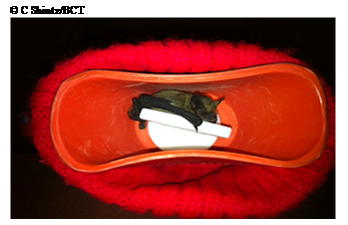
Luckily, thanks to the work of Bat Helpline Officers, volunteer bat carers and concerned members of the public, many grounded bats can be saved. My colleagues give advice on how to safely move bats to safer places using gloves, tea towels and shoeboxes. They can help callers keep a bat in a safe container, with a bit of water in a bottle top for it to drink. In more serious cases a volunteer bat carer will often be needed. Trained in how to care for these tiny creatures bat carers can often rehabilitate bats before releasing them back into the wild.

Rescued Bat and Suckling Baby Bat by Steven Allen. Used with permission.

But by early July, the Bat Helpline phones should be ringing with different calls. By now, the Bat Helpline is usually busy with home owners reporting maternity roosts or people who’ve found a baby bat taking a wrong turn and ending up in the bathroom! But this year it looks like many maternity roosts have remained empty and abandoned with no mothers returning and no baby bats being born in there. Our first baby bat call arrived nearly a month late and we only had about 20 calls about baby bats by the end of June. These few babies will be in for a tough time because they only have a few weeks to feed up before autumn and hibernation. If the weather doesn’t improve for bats, bat mothers will have fewer nights to hunt, there will be fewer insects to catch and little time for the young bats to learn how to fly and hunt for themselves. We may well have some more exhausted bats later in the season.

But we don’t know yet if this summer’s weather is behind the reports of empty roosts and grounded bats, or whether it will have long lasting consequences for our bat populations. However, thanks to the National Bat Monitoring Programme volunteers we will find out. Volunteers are out scanning the skies and counting bats going in and coming out of roosts so that we can build up a picture of how bat populations are faring and what’s affecting them.

Hedgerow in Suffolk by Tom Need. Licensed through Creative Commons.

Like many people who haven’t seen bats this year, I feel like a part of summer is missing and I don’t know when it will come back. But in the meantime here at BCT we hope our bat walks aren’t washed out, and we continue to work for bat friendly practices in woodlands, cities and rural areas. We’re also grateful that volunteer bat groups and roost visitors all over the country are working tirelessly to ensure their patch is the best it can be for bats and that bat carers are on hand to help grounded and injured bats. And while it is not easy to sleep at night knowing the skies are empty outside my window, I know when summer does arrive we’ll have made Britain better for bats and for all of us too.

Do your bit for bats - support the Bat Helpline today!

Let us know on Twitter if you’ve donated: @_BCT_ or #BatlessSummer

Thursday, 22 March 2012

Habitats Directives Review

Julia Hanmer, Chief Executive, welcomes some of the results of a government review of the legislation that protects wildlife habitats, which has taken on board many of the Bat Conservation Trusts recommendations. In this blog, Julia explores the Review highlights, and considers how to build on our hard work as we await critical decisions on planning rules.

Caroline Spelman, Secretary of State for the Environment, announced today the results of the Habitats Directives Review. The Chancellor’s original announcement of the Review in his Pre-Budget statement last autumn caused huge concern at the rhetoric used to attack this important legislation. So I am really pleased to see that the results of the review take account of the widespread evidence we put forward to demonstrate that the Habitats Directive, far from being a burden to business, is a vital element of the mix of approaches needed to achieve sustainable development.

Many of the points in our consultation response, and in those of our fellow wildlife NGOs, have been included in the recommendations. BCT called for the Review to focus on strengthening standards of professional practice, supported by well informed decision making, with an overall aim of meeting the Biodiversity 2020 targets. I am heartened to see that, as we asked, there is a focus on providing people with better access to the expertise, information and evidence that we all need to implement the Directives more successfully.

We are delighted at the inclusion of our recommendation that mitigations made to replace habitats lost through development be monitored and evaluated to ensure their effectiveness. There are positive measures to increase data sharing, and to achieve evidence-based implementation of the Directives. The recognition of the need for industry agreed standards is also welcomed. However, it is important that mechanisms are introduced to endorse and enforce standards effectively, particularly given the introduction of broarder class licences, otherwise we are in for a bumpy ride which could trigger further complaints about the Habitats Directives. The news that this consultation will continue over the next 12 months is encouraging, and I look forward to continuing to engage with this process as there is still much more to be done to ensure smooth implementation.

We warmly welcome the commitment made by Ministers to the importance and purpose of the Habitat Directives. These Directives provide an essential mechanism for safeguarding vulnerable species and habitats whilst ensuring social and economic needs are met. Defra can be congratulated for taking charge of the Review process and listening to the evidence submitted. Their next challenge is to ensure other government departments fully adopt the commitments the Government has already made in the Natural Environment White Paper.

Only yesterday we saw the Chancellor have another a dig at the environment during his budget announcement, when he said:

'Environmentally sustainable has to be fiscally sustainable'.

I think, like RSPB, that this is the wrong way round. As the White Paper states:

‘A healthy, properly functioning natural environment is the foundation of sustained economic growth, prospering communities and personal well-being’.

We need to see more joined up recognition of this across government.

I therefore wait with interest to see whether the National Planning Policy Framework, to be announced next Tuesday (March 27), will recognise that the environment is at the heart of sustainable development and that without environmental sustainability there can be no economic sustainability.

Monday, 12 September 2011

Listening to the public, speaking for bats – The Bat Conservation Trust National Helpline – some things I’ve learnt....

It is estimated that by 2030 a staggering 92 percent of us will be living the ‘urban life’. This is quite a shocking projection, and if it is to be anywhere near realised within the next two decades, it will be at the expense of large parts of our countryside, with cities and towns continuing to eat up important natural habitat in order to accommodate a swelling urban population.

This continued loss of natural habitat is a stark inevitability, and although many of our native species are equipped with the behavioural flexibility to adapt to an urban environment, in order to ensure their persistence, we must find means of accommodating and encouraging them within the fabric of our towns and cities. Although protection of habitat remains the cornerstone policy for conservationists, the reality is that many of the species under threat will only stand a chance of survival in the future if we actively pencil them into our urban plans. This requires careful research and consideration of species’ needs, and the ability to incorporate these into an urban framework while not significantly compromising the needs of the human inhabitants.

Additionally, in order for this proximity between man and beast is to be harmonious, effective communication and education must play their part, engendering attitudes of conservation and protection close to home. This is a modern conservation issue, requiring a modern and multi-angled response. The plight of the UK’s bats, and the subsequent work of the Bat Conservation Trust are a very good example of this 21st century challenge; a challenge that will become more and more prevalent with continued urbanisation in years to come.

Although a nation full of animal lovers, the general public’s enthusiasm for our furry, slimy or feathered friends tends to wain once they encroach upon ‘our’ space, or interfere with our day to day existence: thumbs up for nature, so long as it doesn’t mess on my car or down my windows! As well as the issue of habitat loss, an increase of people living the ‘urban life’ creates another challenge for conservationists: a population more and more disconnected from the natural world. Alongside the physical detachment from the country’s plants and animals that an urban migration leads to, our emotional link with many of these precious organisms is under threat; no longer relevant to a generation where blackberries are now seen as an important communication accessory, rather than tasty pie filler! As a result, a great division of opinion exists when it comes to our feelings towards wildlife. This is especially true when it comes to bats, an animal that has been shrouded in myth ever since stories began, and has gothic associations with evil and bad omens that still underlie much public opinion.
Working on the Bat Conservation Trust Helpline means that I come face to face on a daily basis with the extremes of our own reaction to this group of animals, and has frequently left me baffled as to how the same creature can create such polarised opinion; while one person is gushing with admiration and plans of bat adoption over the phone, another would have you believe that the very spawn of Satan has come fluttering in through their window and is now doing laps around the dining room.

Aside from allowing me to conduct my own crude litmus test on bats and public opinion, working on the National Bat Helpline has also highlighted how even the staunchest bat-opposer can have their opinion softened by some well placed facts and reassurance. The detachment that many of us have with the natural world, especially those in urban areas, can be addressed via effective communication and engagement, and the misunderstanding and disinformation upon which fear and irrationality thrives can be lessened.

Although this battle for the public’s hearts is an essential component in the conservation of bats, their future is still very much dependent upon the appropriate application of practical conservation techniques, and implementation of legal protection.

Fortunately, bats enjoy a high level of protection under both EU and UK law, and since the Wildlife and Countryside Act (1981), it is an offense to disturb or harm bats as well as their roosting sites. This protection is paramount to the conservation of bats in the UK. They are an animal with a specific set of needs: a roost site with the correct conditions (normally a separate roost site is required for summer and winter seasons), proximity to suitable foraging sites, and sheltered commuting routes between the two; and if the law permitted easy exclusion of bats from roosts at “un-natural” sites, we would see a huge fall in population numbers, and local extinctions would be likely.

However, despite this protection, even our most common species (pipistrelles) have declined in numbers dramatically over the last few decades. This is largely as a result of changes in agricultural practices and the continued loss of mature woodland. Subsequently, protection alone of roost sites may not be enough to conserve bat populations. Instead, we should seek to actively create new spaces and opportunities for them in future developments located in high bat potential areas. Bats are running out of options, so it is important that new ones are created where possible.

Like bats, artificial roost sites come in a number of different shapes and sizes, reflecting the varying preference and requirements of the different species, but essentially their purpose is always the same: to create a sheltered and protected space for an individual or group of bats as either a transient roost site or for the duration of the maternity and/or hibernation seasons. They have mixed success rates, although continued research is providing us with a clearer picture of their specific needs. Traditionally, artificial roost sites are external structures, attached onto the sides of a building. However, there has recently been the emergence of an alternative, integrated bat box. These are built into the walls of a new property; very much a physical acceptance of the idea of a shared space with nature.

Currently however, the only time that such provisions are required in a build is if it follows the destruction or demolition of a previous roost site. That said, there are still many enthusiastic individuals that go out of their way to consider nature in their planned developments, and working on the helpline, and with the assistance of my colleagues, I have had the pleasure of advising where possible on how best to maximise potential for bats in new builds. The hope is that others can be inspired or encouraged to take similar pro-active measures to conserve our bat species, however, the reality is that effective communication and education on its own is unlikely to guarantee a sufficient uptake of such ideas. Instead, as is often the case, monetary incentives are required as a more persuasive means of ensuring compromises are made for conservation. Subsidies are available for ‘green developments’, but following drops in funding (that has also seen green farming subsidies dangerously cut), only the Sustainable Development Fund (DEFRA) now exists as a source of grants and loans for developments that encourage biodiversity in the UK, with the potential for 75% of project costs being supplied from the fund. If continued development is inevitable, then these subsidies are crucial in ensuring that biodiversity targets are met in new urban areas.


By the continued work of organisations such as the Bat Conservation Trust, there is hope that the potential environmental damage caused by continued urbanisation won’t be sufficient to exclude bats and other UK wildlife from our urban areas, and with a little help, could even bring us closer together. Meanwhile, it is important that we continue providing accurate data on the status of bat populations in the UK to justify their protection, provide support and accurate information to all of those that encounter bats in the UK, mobilise public support where possible, and continue research into these fascinating animals. This, along with the generous work of a large network of volunteers in the UK, will ensure the Bat Conservation Trust is well equipped to take on the modern challenges of protecting a species in the face of continued urbanisation, as well as tackle future challenges that may arise.
The Helpline has a big part to play as well, and it has been a real pleasure to have been able to contribute during my time as seasonal helpline officer.


Please visit http://http://www.bats.org.uk/pages/bats_and_buildings.html for more information about bats in the built environment

David Urry, Seasonal Helpline Officer

Tuesday, 17 May 2011

Flat bats’ Easter adventure along the Forth and Clyde and Union canals

Flat bats’ Easter adventure along the Forth and Clyde and Union canals

British Waterways recently launched this year’s Wildlife survey with bats as their target species. Anne Youngman (Scottish Officer for the Bat Conservation Trust) roped in some pals for a batty waterways adventure. Read on to find out what they got up to and just why waterways are so good for bats.

Our story begins on Easter Sunday. Its features the “Fab. Four”
Anne
John
Dylan (the dog)

And last but by no means least the intrepid explorer.......
FLAT BAT

It also features two Scottish canals;
The Forth and Clyde canal (which goes from the west coast at Bowling to the east coast at Grangemouth )
The Union Canal (which goes from Falkirk into the heart of Edinburgh and is linked to the Forth and Clyde by the Falkirk wheel).

This batty blog shows just why canals can be such brilliant places for bats (and other wildlife), for people and not forgetting dogs, especially rascally ones who like long walks, meeting other dogs and swimming.


The adventure started on Easter Sunday; the sun was shining, the birds were singing so Anne and John loaded up their bikes, harnessed up the dog and grabbed flat bat.

They all took the train from Dunblane to Polmont and then cycled (well, Dylan trotted) the short distance from the station to the Union canal.


Things already look great for bats ...

Note the smooth water - perfect for Daubenton’s bats to feed over,
The bridge – which might provide nooks and crannies for bats to roost in
The trees and bushes which not only attract insects but provide sheltered areas to feed in and land marks for navigation
No street lights - so it’s nice and dark for the shyer bats at night
No cars or lorries – so it’s safe for bats to fly across the canal and along its length with very little risk of traffic collision.

The intrepid gang cycled/trotted eastwards along the towpath all the way to Edinburgh. (A distance of around 27 miles). There was plenty to see along the way and lots of good “batty" features.


The wildflower cafe.


The canals make slower, gentler transport links for people who want to travel by boat, bike or by foot, away from noise and bustle with time to enjoy the sights and sounds around them.
The canals also provide commuting routes and habitat for wildlife, from tiny insects through to birds as big as swans and herons and of course they are great for bats too.


The Avon Viaduct has spectacular views. If you are scared of heights it may be a “knee wobbly” challenge. If you are a thrill seeker is knee/nay bother!


The trip was such good fun that on Easter Monday Anne and Flat bat decided to explore the Forth and Clyde canal. They took the train to Glasgow joining the canal at Maryhill locks, then cycled eastwards to Polmont (A distance of around 30miles).


There was plenty of wildlife and wildlife signs along the way. Otter spraints were noted under many of the bridges, particularly the new ones (perhaps the spraints are just easier to see on the smoother stones).
Cycling into swarms of flies was a pain in the eye – but at least it means the bats and fish have plenty of food.
Orange tip and peacock butterflies fluttered by but would not stay still long enough to be photographed. Anne had more luck with swans, who either continued feeding or sitting on their nests


After about 25 miles the fantastic Falkirk wheel came into view. The Wheel is a boat lift which links the Forth and Clyde canal with the Union canal.


Sadly not long after Falkirk it was time to leave the canal and get a train back from Polmont station and home to Dunblane.


The end of a perfectly batty adventure along beautifully batty waterways, or is it? What will the intrepid Flat bat get up to next?????? Watch this space.

Written by - Anne Youngman
Scottish Bat Officer


Further info /useful links
To make your own flat bat to take on an adventure
Insert BCT link http://www.bats.org.uk/publications_download.php/619/Flat_Bat.pdf

For more information on British waterways Wildlife survey

Wednesday, 2 February 2011

Sleeping Batties

Bookkeeper Jane Collett tells us about her first bat outing, where she helped out with a hibernation survey in a disused London tube tunnel..

10.00 - I’m ridiculously excited about today’s hibernation count. Although I joined the Bat Conservation Trust in May, as part-time bookkeeper I had not managed to attend any bat events up until now. The meeting point isn’t far from home so this is a great opportunity. Excitement is tinged with trepidation, as I’m quite claustrophobic and spending hours locked in a dark tunnel isn’t usually my idea of fun…

11.15 - Set off to walk through some woods to our rendezvous. It’s a raw January day and I’m dressed in so many layers I feel like the Michelin Man.

12.15 - We’re ready to start - a mix of Bat Conservation Trust staff, friends and local bat enthusiasts as well as members of the London Bat Group. I’m joined by my friend Wayne, a keen naturalist, who lives nearby. Cindy Blaney of London Bat Group, briefs us. Previous surveys of the two disused railway tunnels have found mainly Natterer’s, some Daubenton’s and a single brown long-eared bat. Then we’re off on the short walk to the tunnels’ entrance. I’ve looked down on them from the main road hundreds of times, but have never seen them from this perspective. We divide into two groups. Nine Bat Conservation Trust staff and friends go with Philip Briggs from the National Bat Monitoring Programme. Philip explains likely places to find bats. On the tunnel walls, there are “crusts” of sooty deposits from when trains used to pass through, and bats hibernate in spaces where these are peeling away; there are also a number of bat bricks in the walls. Five of us slowly work our way along one side of the tunnel, five along the other. We have to walk carefully as there’s rubble in places, and railway sleepers to negotiate. I realise that my torch, which seemed pretty good at home, is really puny in this vast dark space. It isn’t long before the first bat is found, a Natterer’s, in a bat brick. It’s great to see it, and we gather round to take a look. Soon there’s another discovery, another Natterer’s, this time behind one of the crusts. For long periods we work in silence, the only sounds our footsteps and the rumble of tube trains. I’m at the end of the line of surveyors and at one point think I’ve found a bat not previously spotted. It’s possible to see much more of this bat – the length of its wing, part of its white front and its face. It’s beautiful. Although it turns out that the bat has already been counted, I’m still thrilled.

14:00 - We leave the tunnels, having found six Natterer’s bats in our tunnel – a disappointing number compared to previous years. But I’ve really enjoyed the experience and feel very privileged as you can only enter a bat’s roost if you are accompanied by someone with a special licence.It’s getting pretty cold, despite all the layers, and several of us retire to the local pub to warm up.

(Please note it is illegal to enter a bat hibernation roost unless accompanied by a licenced bat worker)


National Bat Monitoring Programme The Bat Conservation Trust runs a number of nationa and annual surveys through a volunteer network to monitor the status of many of our bat species across a range of habitats. Our surveys form the National Bat Monitoring Programme through which we track changes in bat populations. Monitoring bats is essential as over the last 60 years it would seem that many of our bat species have declined dramatically. The data collected allows us to: •Assess the conservation needs of the UK's 18 species of bat •Identify any rapid declines •Select conservation priorities and inform conservation policy •Ensure limited resources are directed to where they are most needed. If your are interested in finding out more about becoming a NBMP volunteer, please email Felicity Bates (fbates@bats.org.uk).